


Consistency is the name of the game for the top firms in the AHF Top 50 Developers of 2014.
The Michaels Organization, The NRP Group, McCormack Baron Salazar, The Woda Group, and The Pacific Cos., all of which saw strong construction activity in 2013, continued to post big production numbers last year to remain in the top 10.
In fact, construction activity increased for the AHF 50 developers overall last year. The group started 240 new developments with more than 19,000 affordable housing units in 2014, an 18% increase in units from the prior year's group. (For the past two years, there have been 56 companies on the list because of several ties.)
Marlton, N.J.–based Michaels, No. 6 on last year's list, rises to the top spot this year, after starting construction on nearly 1,300 affordable housing units in seven developments in 2014.
The new developments were a good blend of housing—three communities for seniors and four for families, says Ava Goldman, president of Michaels Development Co.
Goldman credits the firm's strong team of developers and construction managers. "From our home base in New Jersey to the South, Midwest, West, and even the tropics [the U.S. Virgin Islands], we have a highly motivated and capable staff," she says.
To be considered for the AHF 50, 107 firms completed surveys, detailing their recent activities. The list reveals how many units are under construction by leading national and regional developers. The rankings are based on the number of new affordable housing units—those serving residents earning no more than 60% of the area median income—started in 2014.
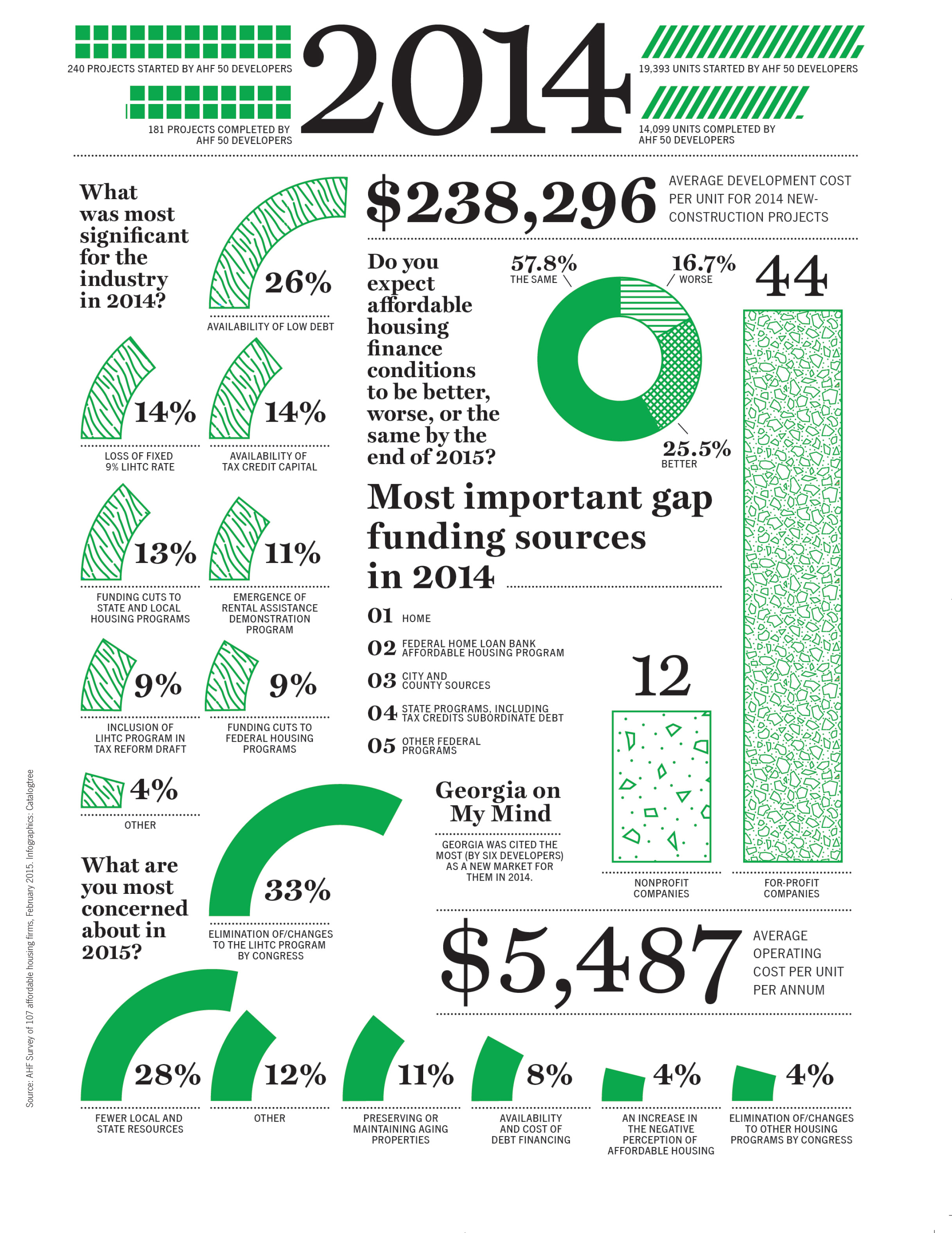
Overall, the group is an optimistic bunch. A majority (57.8%) of the surveyed companies believe housing finance conditions will remain the same this year. About 25.5% say conditions will be better, while only 16.7% think conditions will be worse by year's end.
Jeff Woda, president of The Woda Group, No. 6 on this year's developers list, says the outlook for the affordable housing industry has never been better.
"The demographics are really working in our favor," Woda says. "We have a very strong, if not infinite, demand for affordable rental housing. The investor appetite is strong, and capital is available again. Financiers realize our deals are strong and can weather bad times. We're extremely bullish on our industry, and we think it's the best place to be in the real estate development world."
Indeed, the capital markets have been prime for developers and key in helping them make their deals work. The surveyed companies picked the strong availability of low debt as the most significant factor for the industry last year.
Looking ahead, developers are most worried about the elimination of or changes to the low-income housing tax credit (LIHTC) program, edging out last year's top concern of having fewer local resources.
Finding gap financing, too, continues to be a hurdle. Woda says his firm has recently used resources that it hadn't thought about before, including payments in lieu of taxes and tax abatements.
"As communities realize workforce and affordable housing are key to their growth, they're openly working with us to make these deals work," Woda says.
If expectations hold true, the AHF 50 developers will build even more housing this year. They project starting construction on a collective 300 developments with about 26,000 affordable units.
See the complete developers list.
Top 50 Developers Spotlight
#6 The Woda Group
The Woda Group continues to post strong affordable housing numbers year after year, ranking in the top 10 of AHF's developers list for five consecutive years.The firm, headed by principals Jeff Woda and David Cooper Jr., started 17 developments with 723 units and completed nine projects with 386 units in 2014.
Woda is also ramping up for a strong 2015, expecting to start 14 developments with 556 units and to complete 28 with 1,184 units.
"Our key to success is, first and foremost, that we have developed a great staff of development officers who cover a 13-state area, and they've been able to strategically identify markets and types of housing that we want to develop and match states' qualified allocation plans," says Woda, president of the firm. "We're really seeing the fruits of that labor."
A company highlight last year was the completion of three historic rehab projects. Woda says typically the firm does one historic deal a year, but three had been brought to Woda in communities where it had developed previously or close by.
Historic icons Columbus School in Baltimore; Lloyd House in Menominee, Mich.; and Washington School Apartments in Washington Courthouse, Ohio, all were financed with a combination of low-income housing and historic tax credits.
"They're providing quality housing with buildings we were able to save," says Woda. "They're some of the best developments we have ever done." —C.S.
#19 Dunn Development Corp.
2014 was one of the busiest and most successful years for Dunn Development Corp., according to the company's president, Martin Dunn. The firm started more than seven times the number of affordable housing units and completed more than three times the number of units it did overall in 2013.
The Brooklyn, N.Y.–based firm also made its first foray into market-rate homeownership projects and closed its largest single project to date in the borough's East New York neighborhood.
Livonia Commons, with total development costs of $90 million, will help rejuvenate a commercial corridor in East New York that suffered from disinvestment during the 1960s and 1970s.
The mixed-use project will include 278 units of affordable housing across four buildings, with more than half of the units for households earning less than 40% and 50% of the area median income. Fifty-one units of supportive housing will be included in the project with supportive services from CAMBA and The Center for Family Support. The property also will have 28,000 square feet of retail and community space.
Dunn says he expects the first two buildings to open this fall and the second two in the first quarter of 2016.
The last component, which has yet to start construction and is in the planning stage, is a 50,000-square-foot Boys Club of New York.
"It's a very exciting, transformative effort for the neighborhood," says Dunn. —C.S.
#41 Community HousingWorks
When California dissolved its redevelopment agencies (RDAs), developer Community HousingWorks had to look at its business plan and rethink how it would grow.
The San Diego nonprofit made a strategic decision to pursue acquisitions as part of its multifamily line of business in addition to its new-construction, transit-oriented affordable housing projects.
"It's very important to keep a balance there. There needs to be a healthy balance of new projects that won't need attention physically for the next 15 to 20 years and acquisitions that have different needs," says Anne B. Wilson, senior vice president of housing and real estate finance. "In spite of the loss of the RDAs, we can keep that balance."
The company's multifamily division executed on that balance in 2014, acquiring Community HousingWorks' largest single community, with 200 apartments; acquiring and rehabilitating an 88-unit project; and breaking ground on two 9% low-income housing tax credit developments.
"We've been building that up for a couple of years, but it takes time to get your foot into the acquisitions market," says Wilson. "I think we've been very successful in making acquisitions and competing in that marketplace."
The coming year will see more of that combination of work. The nonprofit plans to celebrate the completion of two projects, including the North Santa Fe Apartments in Vista, Calif., and close the financing and start renovations on 448 units in five projects. —C.S.